Monday, June 10, 2013

Gov. Pat McCrory calls "Moral Monday" unlawful and acceptable

"We welcome feedback, we welcome lawful demonstrations, however, we don't welcome unlawful demonstrations, and that should not be accepted," Gov. Pat McCrory said on Tuesday, according to WTVD.

Note the insensitivity.  Note the righteous indignation.  North Carolina’s Governor has resorted to labeling the actions of protesters criminal.  300 have willingly gone to jail to show disdain over a series of laws passed by the Republican controlled General Assembly.  McCrory’s attack of demonstrators reflects a broader negligence toward those in opposition.

McCrory said he has no intent in meeting with members of the NAACP, student unions and environmental groups to discuss their complaints with the GOP. McCrory told WTVD the demonstrations were “unlawful” and therefore “unacceptable.”

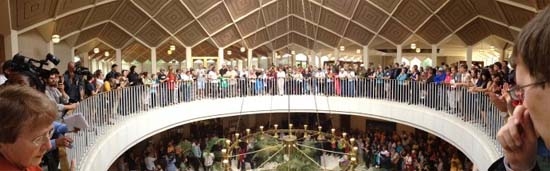
 So Gov., are you serious? Do you really believe the 1,600 people who showed up last week for “Moral Monday” are criminals who have no right to show up to attack legislation that makes it harder  for the poor to survive?  Do you really think it’s criminal to stand against a voter ID law that will impact the poor and senior citizens?  Are we supposed to bow at your moves to pave the way for hydraulic fracking, cuts to education spending, rejection of Medicaid expansion under Obamacare and cuts unemployment benefits?

Maybe, just maybe, the Governor thinks he can get away with tagging protestors as a gang of angry blacks and throw back hippies.  What better way to swing public opinion in his direction than to challenge people to consider the illegitimate conduct of the mob? It’s just “those people” complaining again. 

Really? All of them?

Maybe it would help the Governors cause to fail to mention that most of those arrested are not black.  Many are older citizens pissed off at how Republicans have systematically turned that clock back to a time when the state was ruled by white men with no regard for equal opportunity and social justice.

McCrory, and his gang of legislators, are the anti-Obama.   Seemingly, the plan is to separate North Carolina from a national agenda.  Sound familiar?  The call for state rights makes you wonder about a plan for secession from the union.

Read Civil War 101.

The movement back is reflected in a charter school agenda that has effectually re-segregated public education.  The rhetoric of poor academic performance functions to electrify support among disgruntled black parents and white parents in search of schools that offer an academic advantage for their children.  Lingering beneath the language of public education is a social agenda rooted in the hysteria stirred by race.

Policy makers continue to play games with voters while burying their racism under the chatter of accountability and budgetary restrictions.

McCrory calls it criminal to expose the other side of social change.  He calls it illegal to protest what many consider heartless, immoral and reckless.  It’s called “Moral Monday” for a reason.  Those gathering each Monday are challenging the GOP to be guided by a morality that supersedes a political agenda.  McCrory’s branding of the “Moral Monday” crowd fails to state the obvious – that protesters are showing up because Republicans, in their minds, are a gang of thugs devoid of moral integrity. 

That point is reflected in comments made during a Tuesday protest held Charlotte, NC. Kojo Nantambu, president of Charlotte’s NAACP, called Gov. McCrory "one of the most wicked people I’ve ever met."

McCroy’s vilifying of ‘Moral Monday” protesters snubs the resolve of those willing to make the trip to Raleigh each week. McCroy may consider their presence “illegal” and “unacceptable”, but the actions of the GOP is worse.

Laws passed by the GOP are immoral, wicked, dishonest, sinful, corrupt – pick the word that best reflects the mean spirited actions of those who use the law to enforce an old agenda.  The actions of protesters may be unlawful.  Their actions may be unacceptable to members of the GOP.  That may be true.

But if I’m one, what does that make you?  Insert playground taunting of youth.

What is a moral law? Moral laws are rules of behavior an individual or a group may follow out of personal conscience and that are not necessarily part of legislated law in the United States. Moral law is a system of guidelines for behavior.  For me, moral law is tantamount with the demands of my spirituality.  Some regard them as a set of universal laws that apply to everyone.

The actions of the GOP violate moral law.  Acts of civil disobedience are designed to remind those in power of a law greater than the laws they make.  The Governor calls their actions illegal.  His response, and the actions that preceded his response, are immoral.

The GOP’s response is to send some to jail.  For many who have protested against the GOP, there is a place worse than jail reserved for those who violate moral law.

I call that unacceptable.

Others call it Hell.

Friday, June 7, 2013

Racist judge is not alone: Elegy of an unjust system

Judge Edith Jones is a racist.

My father once told me he’d rather a person calls him a Nigger to his face than to share those feelings behind his back.  That way you know who you’re fighting against.

My issue with the Klu Klux Klan is more about the sheets they wear.  They have a right to share their feelings, but show your face and buckle down for an ass whipping once the fire dies down from that burning cross.

I’ve always known judges hold racist views toward black and brown people.   You can tell by the way they manage proceedings in the courtroom.  Spend some time at your local courthouse and you will soon discover that justice is unjust for people of color. 

Many are assumed guilty before they step in the room.

Those called to administer the law cling to racist notions that have deep bearing on the verdicts they hand out.  It’s all part of the game that has long been preached among those who fight for the Racial Justice Act and the revamping of a system made dirty by the views of those who hold the power to take freedom away.

The outrage over comments made by Judge Edith Jones make it easy to overlook she is not alone.  Jones is judge of the 5th U.S. Circuit Court of Appeals.  On Feb. 20, during an address at the University of Pennsylvania law school, Jones was heard saying “racial groups like African-Americans and Hispanics are predisposed to crime," and that they are "prone to commit acts of violence" and be involved in more violent and "heinous" crimes than people of other ethnicities.

A formal complaint was filed Tuesday by several civil rights groups, including one funded entirely by the government of Mexico.  The complaint alleges Jones said Mexicans would prefer to be on death row in the U.S. than serve prison terms in their native country, and that it's an insult for the U.S. to look to the laws of other countries such as Mexico.

The charges against Jones are laid out in a 12-page complaint filed in New Orleans where the appeals court is based. The affidavit contends Jones engaged in conduct that "undermines public confidence in the integrity and impartiality of the judiciary, and creates a strong appearance of impropriety."

Jones was appointed to the court by President Ronald Reagan in 1985.  She has served as chief justice since October 2012.

The complaint also claims that Jones said defendants' claims of racism, innocence, arbitrariness, and violations of international law and treaties are just "red herrings" used by opponents of the death penalty. She allegedly said claims of "mental retardation" by capital defendants disgust her, and the fact that those defendants were convicted of a capital crime is sufficient to prove they are not "mentally retarded."

The complaint claims she said a death sentence provides a service to capital-case defendants because they are likely to make peace with God only just before their execution.

Members of the coalition formed to address Jones’ said her comments resembled those made during the trail of Duane Buck.  Buck, a black man in Texas, was sentenced to death in 1997 for the murder of his former girlfriend and another man.  During Buck’s trial, a psychologist listed race as a factor in Buck continuing to pose a risk.  Although called to the stand by the defense, the prosecution used the testimony in her closing argument.

John Cornyn, then Texas Attorney General, used the case to show how race played a role in determining death sentences.

"Judge Jones's comments are frighteningly similar to those that violated Duane Buck's constitutional rights," said Christina Swarns, one of Buck's lawyers and director of the Criminal Justice Project of the NAACP Legal Defense & Educational Fund.

The uncovering of Jones’ racist agenda came hours before the repeal of North Carolina’s Racial Justice Act.  The law allowed death-row inmates the right to challenge their sentences based on racial bias claims.

Under the law, inmates were allowed to use state and county statistics and other information to claim race was a factor in determining their sentencing.  Opponents of the law say the law clogged up the courts and has denied justice to victims.

Jones’ comments demonstrate how race is used to determine the fate of those charged with crimes. Most disturbing involving the discussion related to Jones is the lack of deeper dialogue regarding how her views are part of the common culture among those who rule the law.  The fallacy of a colorblind system becomes more perplexing when it lacks the type of checks and balances critical in protecting those assumed guilty based on their race.

America’ problem goes deeper than state legislators are willing to concede. The magnitude of the problem can be traced to President Richard Nixon.  In 1973, Nixon created the Drug Enforcement Administration (DEA) as a way to target black people.

“You have to face the fact that the whole problem is really the blacks. The key is to devise a system that recognizes this all while not appearing to,” Nixon is quoted saying in Dan Baum’s Smoke and Mirrors: The War on Drugs and the Politics of Failure. Baum lifted the quote from the diary of Nixon’s Chief of Staff, H.R. Haldeman.

Nixon’s war on drugs was an all-out war against black people.  Jones proves an agenda to continue the strategy of Nixon.  The state legislator preserves the same by failing to acknowledge the link between race and incarceration.

Jones is an old fashioned racist wearing a black robe.  I’m beginning to wonder if those serving state government have a white robe in the closet.

I’d rather they call me a Nigger to my face.

Start running when the fire goes out.

Wednesday, June 5, 2013

Mumia: Each word I write

I like writing with noise.  Lots of it.

The sound of music in the background helps stir my creative juices.  I’m moved by the conversations of others as I take note of the looks on their faces.  The cries of children aren’t a distraction.  They assist the bubbling of my creative juices.

I have problems with silence.  I grapple with being imaginative when forced to contend with being in the presence of no one but me.  I’m not sure what that’s about.  Is it my need to be surrounded by people, or my fear to confront the madness in my head?

My failure with being alone intensifies my respect and admiration for Mumia Abu-Jamal.  He’s done it for 30 years.  He sits, alone in silence, and writes.  He writes, and writes and writes some more.  He reads and writes.  He creates alone in a space reserved for those punished for violating the law. 

He keeps writing – alone.

Abu-Jamal creates commentary to be read on his radio broadcast.  He has written thousands of essays since being locked up for the death of a Philadelphia police officer.  Abu-Jamal’s supporters contend he’s innocent.  As they fight, he writes. 

He writes alone.

He’s done it devoid of the comforting words of a partner.  He strokes pen to paper like a man making love.  The words appear like moans gratified after each stroke.  Abu-Jamal reads books like love notes. Knowledge is his romance.  Truth is his best friend.

Being alone came to me upon watching the film Mumia – Long Distance Revolutionary.  The thought of being trapped in a space the size of a bathroom left me saddened.  Could I do it?  How could I do it?

How does Mumia find the strength to keep writing?  Where does he find the motivation after being denied human touch? I need hugs to keep me going.  I need the words of others and the smiles of others to keep me inspired.  How does he do it? 

Could I do it?

Mumia’s strength left me ashamed of my complaints.  How can I write when I lack support? How do I write when there isn’t enough to sustain my work?

How, how how? Why, why, why?

The mounting list serves to defeat the power of my words.  The complaints bear witness to the truth of selfish ambition.  The words aren’t written to expose darkness.  They aren’t aimed at correcting the wrongs that burden those I write about.  The words are about me. Only me.  Not them and their need for advocacy, but me and my need for approval.

Shame takes hold.

Mumia writes.  He does it not to advance his career.  His sights aren’t locked on the next big move.  He writes for the sake of truth.  Not for affirmation.  Not for upward mobility.  It’s about the words.

Behind walls with no keys to unlock, he writes.  There with no one to read his words.  No one to nod in approval.  The only voice is his own.  His companions are the books stacked high to challenge his thoughts.  No smiles.  No one to touch.

The image of Mumia consumes me.  Eyes closed now.  Two deep breaths to channel his spirit.  Two more to beg for more than I’m prepared to give.

“Lord, I take freedom for granted,” I pray.  “Forgive me for forgetting the reason for this gift.  Not my will, your will be done.”

I pray for the freedom of all political prisoners.  I pray for the brewing of a love greater than the hate.  I repudiate the hate that keeps Mumia bond. 

“Use my words to set the captives free,” I pray some more.  “Teach this nation the truth of its hate.”

Then it came to me - a voice too far for my eyes to detect its origination.  It came from a place deeper than my fears – somewhere beyond the shadows of my disappointment.

“Do it for the people.  Do it for the love.  Do it for the love of the people,” it spoke.  The unknown, undeniable truth spoke.  It spoke to me.

A voice greater than gender or race spoke - use your words wisely.  Speak to the world and remind them of the purpose of our creation.  Challenge them with your words.

And remember, it’s never been about you.

Write Mumia.

For the rest of my life, each word I write is dedicated to you.

Monday, June 3, 2013

"Moral Monday": It's personal

The bullies in Raleigh have to be stopped. Yes, they must be stopped by “any means necessary”.  My Malcolm X alter ego just showed up.

The outcry from disgruntled citizens is picking up pace.  It’s hideous what Republican lawmakers have done in North Carolina.  Yes, Hell yes, it’s immoral.  The zeal of God is screaming for justice, and those with sense enough to read between the lines of political bull stank are showing up to fight the power.

So far, 153 have been arrested.  They show up every Monday at the North Carolina state legislative building to cry for change.

They call it “Moral Monday.”

The singing and chanting feels like old school, with warnings of pending arrest if protesters refuse to stop the clamor.  General Assembly Police Chief Jeff Weaver shouts like a resurrected Bull Conner with bullhorn in hand to remind protesters they are trespassing.

You are left feeling Weaver doesn’t want to play this weekly game of forcing people to go to jail for no other reason than expressing their ire toward those who use power like an assault weapon.  Those shouting for justice are enraged over a series of polices pushed by the Republican-controlled General Assembly. The list of woes includes budget cuts to education, abortion access, immigration rights, voting law changes and health care policy.

The mounting rise of resistance sends a clear message – this is a Civil War.  The backlash is met with an arrogant indifference that escalates the voices of those crying for justice.  Lawmakers haven’t spoken.  They remain glued to their inflated assumptions of privilege while refusing to listen to the pleas of those on the outside.

They could care less.

They function with a pride that fails to concede the handwriting on the wall.  Yes, judgment day is coming soon.  Yes, their reign of terror will end soon.  Those screaming hold the power of the ballot, and failure to acknowledge their presence will brew like lava waiting to explode.  This thing is rapidly building.  It will not stop.  Soon, it will be out of control.

No statement from the Governor.  No word coming from those who cast votes like a madman with a whip.  Sorry folks, this is not your granddaddy’s Dixie.  That approach may get you elected, but will it be enough to keep you in that job that feeds your conceit?

I plan to join the line of protest.  I plan to take my seat next to others willing to be arrested.  I’m aware of the consequences related to taking that seat.  More like me need to stand, but people like me take a greater risk when we decide to fight the powers willing to suck life out of those who scream to be seen.

What is the price of protest?  Will it keep us from finding work?  Will it result in our names being placed on a secretive list designed to punish trouble makers like me?  What happens when you fight the state? Is it worth the risk of not being able to eat?

Hell yes! It’s worth being locked out and kicked out.  Hell yes! I’m willing to fight the power.  It’s worth fighting for those who can’t find work and are forced to contend with less money in unemployment insurance.  After having money taken out of their checks, the state has imposed limits on how much they can receive.  I fight for those without medical insurance.  I fight because that person is me!

I fight despite understanding how it feels to be pigeon-holed as a radical and facing unemployment due to being placed on that secretive list.  I fight despite knowing the dire consequences of being labeled radical devoid of a safety net to pay the bills. 

That’s the real revolution!  It’s not for those who can afford the fight.  It’s for those who suffer when they fight!

They keep coming back.  More are coming.

This isn’t just politics. This is personal.

Friday, May 31, 2013

Does Obama's lack of clarity regarding drones have bearing on Assata Shakur?

On Wednesday, a Pakistani source reported that a United States drone strike killed four people near the city of Mirim Shah.  Wali-ur-Rehman, second in command of the Pakistani Taliban, was reported to be dead.  The group later denied his death.

The drone strike in Pakistan raises questions regarding Obama’s promise.

“Beyond the Afghan theater, we only target al-Qaida and its associated forces,” Obama said in a speech at the National Defense University, “and even then, the use of drones is heavily constrained.”

Obama gave a list of restraints involving the use of drones.  He indicated he prefers detaining terrorist instead of killing them.  He also mentioned respect for state sovereignty and the inability of other governments to control terrorists.  Obama also stated that drones will only be used to target “terrorists who pose a continuing and imminent threat to the American people.”

Is Assata Shakur on that list?

The White House handed out a list of people they will not kill in the future. “The United States will use lethal force only against a target that poses a continuing, imminent threat to U.S. persons,” it stated. “It is simply not the case that all terrorists pose a continuing, imminent threat to U.S. persons; if a terrorist does not pose such a threat, the United States will not use lethal force.”

Why was Rehman a target given a lack of evidence to suggest he is a threat to the U.S.?  The Pakistani Taliban is a threat to Pakistan.  Rehman, according to Mark Mazzetti of the New York Times, is a threat to Britain.  Is the Obama administration using drones to take out the enemies of its allies? If so, does this go against the promise coming from the White House?

A more pressing question is how a lack of clarity regarding the use of drones impacts Americans on the Most Wanted Terrorist list.

The White House has not officially acknowledged the strike against Rehman.  It is not clear if Rehman is considered a “continuing imminent threat” to the U.S. The term “imminence has been used broadly by members of the Obama administration. The terms “associated force”, “co-belligerent” is used to mean “in hostilities against the United States or its coalition partners.” Those hostilities are not limited by time or specific action.

Again, is Assata Shakur on that list?

The Obama administration has argued the placement of limits on the use of drones.  The attack on Rehman begs the question if any restrictions have been imposed on the use of the killer robots.  The New York Times has reported that administration official claim Obama’s restrictions fail to rule out the use of “signature strikes” which allows the CIA and the military to right to kill before knowing the identity of the person.

 The ambiguity regarding the use of drones raises serious questions regarding Assata Shakur being placed on the Most Wanted Terrorist list.  The list is reserved for those considered a “continuing imminent threat” to the U.S.  Has Shakur been placed on the list to pave the way for a drone attack?  If that is the case, should Americans be concerned over a policy that supports the assassination of a person like Shakur. Even more daunting is the possibility of Americans being killed devoid of due process to determine guilt.

Shakur being placed on the Most Wanted Terrorist list alters the conversation related to America’s fight against terrorism.  The USA Patriot Act became law in 2001 to unite and strengthen America by providing appropriate tools required to intercept and obstruct terrorism.  The act was the response to the terrorist attacks of September 11, and significantly reduced restrictions in law enforcement agencies. The act has been used to expand the definition of terrorism to include domestic terrorism. The placement of Shakur on the Most Wanted Terrorist list is proof that the war on terror now includes those outside the purview of al-Qaida.  Included on that list are members of black revolutionary movements.

Is the Obama administration planning to kill Shakur?  If not, why was she placed on the list?  It’s a question that deserves an answer.

Why is she on the list?

Thursday, May 30, 2013

The decade after the deaths of Martin and Malcolm raises questions related to black radicalism, rage and black identity

The decade after the death of Dr. Martin Luther King, Jr. was bunched with massive conflict.  It was a period filled with deep angst after the shedding of a dream.  Inner cities were consumed with a lingering blues that made it hard to believe in freedom.

The time between the deaths of Martin and Malcolm left the black community dazed by what was left behind.  Some held firm to the promise of equality after integration.  Others fought hard to find space among those unwilling to share a bite of the American dream.

The benefactors of affirmative action were left enraged by their continued struggle after making their way to class privilege.  Ellis Cose wrote about it in his book Rage of the Privileged Class: Why Are Middle Class Blacks Angry? Why Should America Care?  Cose cites a large group of well educated, competent, and prosperous black people who are frustrated.  They feel the disdain of white people who see them as weak and unintelligent. They feel the resentment of unsuccessful blacks.  They endure the complexion-based discrimination of blacks against blacks, while fighting the assumption that all blacks are criminals.

The black community swayed between black pride and self-hatred.  The quest for revolution was met with condescension among those dedicated to promise of integration.  Afros and dashikis were exchanged for low-cut fades and three piece suits. The pursuit to claim a unique racial identity was viewed as a barrier in finding space to fit into the American melting pot.

The decade after the deaths of King and Malcolm witnessed the unfolding of Roots.  Alex Haley made It trendy to claim pride in being connected to the motherland.  Massive imagines of blacks dancing and singing to African beats was juxtaposed against the need to fit.  It was a period of striving blended with a need to claim African roots all while fighting the inner city blues.

It was the decade of black exploitation films.  The rage of the inner cities led to the rise of a counterculture unwilling to bow to the demands of white privilege.  It was the age of redefining black identity by celebrating ghetto culture.  Keeping it black meant more than the celebration of African pride.  It meant keeping it gangsta.

Richard Majors and Janet Billson talk about it in the book Cool Pose: The Dilemmas of Black Manhood in America. They related the mask of cool used by inner-city youth to defend themselves against the injuries of ghetto life.  The pose is yet another way to define authentic black identity.  Does anyone know what that means?

The decade after the death of King and Malcolm forged a deep wedge among a people seeking to define what it means to be black.  Some embrace the culture of the ghetto.  Others find solace in claiming African roots.  Others seek to melt into the larger culture through education, politics and by celebrating the privilege of middle-class social identity.

Lost in most dialogue related to study of race and class in America is a clear focus on the decade after the death of King and Malcolm.  It was an era of protest fueled by police brutality.  Most studies of the decade leave people bewildered by black protest.  Few stop to consider why they were fighting the police while demanding rights many felt had been achieved.

What motivated Huey P. Newton and Bobby Seale to start the Black Panther Party?  Why was Angela Davis arrested?  Why did Assata Shakur escape prison and flee to Cuba?  What is the truth behind the arrest of Mumia Abu-Jamal?  What hasn’t been told, and why is the Fraternal Order of Police fighting so hard to keep people from hearing the rest of the story?

What is the politics behind the telling of the story?  What happened with the Wilmington 10?  What happened in Watts to start that riot?  What happened in Detroit in July 1967 that left 43 dead, 467 injured, over 7,200 arrested, and more than 2,000 buildings destroyed? 

Why did black people burn down their own neighborhoods?  Why did it happen after major Civil Rights victories? Something was wrong in Newark, NJ where Assata Shakur was arrested. 

What led to the armed standoff between Philadelphia police and the group MOVE on May 13, 1985?  Another decade of indifference fueled even more discontent in America’s inner cities. A police helicopter dropped two one-pound bombs on the roof of the house occupied by members of the group. The fired destroyed 65 houses and killed 6 adults and five children.

It’s a period that deserves to be studied.  Underneath the assumptions of guilt are motives and fears that stirred a revolution.  What are those untold stories, and how do each help facilitate views of racial identity and pride?

These are some of the questions that led me to bring Mumia – Long Distance Revolutionary to the Carolina Theatre.  I hope you can join us for the beginning of a broader conversation related to the decade after the death of King and Malcolm.

There’s so much to learn.  Let the learning begin.

Tuesday, May 28, 2013

"Mumia - Long Distance Revolutionary" to examine the life behind the long run

Many consider Mumia Abu-Jamal a political prisoner.  They contend it isn’t the death of a police officer that keeps him in prison.  His voice hasn’t been silenced since the night he was arrested while moonlighting as a taxi driver to make money to add to what he made as a journalist.

He didn’t stop writing.  He continues to lead and inspire others to liberate the masses.  Abu-Jamal says he has been “punished for communicating.”

Mumia- Long Distance Revolutionary documents Abu-Jamal’s childhood, his work as a journalist with the Black Panther Party Newspaper, the FBI’s COINTELPRO program, and the reason behind him being forced to moonlight as a taxi cab driver the night he was arrested for killing Daniel Faulkner, an officer with the Philadelphia police department.

The film will be shown at the Carolina Theatre in Durham on June 3 & 4. There will be two showings on Monday (7:00 pm & 9:20pm), and one showing on Tuesday (7:00 pm). A panel discussion follows the June 4 show with a special introduction of the new short film Manufacturing Guilt, about Abu-Jamal’s innocence.

Jamal Hart, Abu-Jamal’s son, will participate on the panel. 

“I became a priority adverse target to further punish my father,” Hart says. Mumia – Long Distance Revolutionary has helped Hart deal with some of that hurt.

“It’s like being brought back in time – a glimpse of the past,” Hart says. “Seeing an active journalist doing what he loves. My beloved father being the voice of the voiceless.”

Keith Cook, Abu-Jamal’s brother, will also be on the panel.  Cook, who lives in Hillsborough, NC, says the film has made him much more knowledgeable of the details of his brother’s case.

“If you grew up in Philadelphia, very rarely did the press say anything positive about Mumia. They portrayed him and convinced a large portion of the city that he was guilty of a crime that he did not do,” Cooks says. “This film has been good for me and Mumia and all the people around the world who have been struggling hard to get positive pictures and words out about Mumia and his case.”

Rachel Wolkenstein will also be on the panel. She is an attorney, political activist and spokesperson in the fight to free Mumia Abu-Jamal since 1987.

“Long Distance Revolutionary, is a powerful explication of and testament to the character of this man--innocent of everything except being an uncompromising voice for justice against the forces of race and class oppression,” Wolkenstein says.

Noelle Hanrahan will also serve on the panel.  Hanrahan began recording Abu-Jamal’s voice in prison when she recorded him on death row at Huntingdon State Prison in July of 1992. These recording sessions lead to her recording the controversial censored series on National Public Radio as well as Abu-Jamal’s first bestseller “Live From Death Row.”

Stephen Vittoria directed and produced Mumia – Long Distance Revolutionary.  Vittoria says his first goal was to tell a good and strong story that is well-researched.

“Mumia Abu-Jamal's life is a remarkable story, one of courage, compassion, and love, oftentimes under harsh an inhuman conditions,” Vittoria says. “In fact, the so-called public narrative of Mumia's life told by the lap dogs in the mainstream media and their corrupt masters, the power-brokers pulling the strings, has been a combination of myths, innuendo, and outright lies.”

Vittoria says he has been surprised that Abu-Jamal’s lifelong struggle against racism and class oppression has not been fueled by the politics of rage but rather by love.

“I've told many people that this film, for me, is the film of a lifetime,” Vittoria says. “If I never make another film after this one, that's okay. This film captures the essence of its subject, Mumia, as well as my essence as a filmmaker - both creatively and politically.”

Vittoria says the response to the film has been one of the best parts.

“The audiences are passionate, inspired, and very vocal with their embrace of the film - and that's because Mumia's spirit is one that inspires people everywhere: his struggle, his steadfastness, and his uncompromising approach to telling the truth,” Vittoria says

Cook says he’s optimistic that his brother will be released.

“I go bed sometimes thinking about what I can do next or what are the next steps,” Cook says. “And I am concentrating on having him free in my lifetime.”

It’s a long run to freedom.  It’s even longer when you’re a revolutionary.

Mumia Abu-Jamal keeps running the long distance to freedom.

Friday, May 24, 2013

"Mumia - Long Distance Revoluntionary": Why you must show up

Full Frame didn’t select it as one of the documentaries shown at their film festival.  Shaq pulled the plug on it being shown in Newark, New Jersey.  The Fraternal Order of the Police is fighting to keep people from hearing the story. 

Mumia – Long Distance Revolutionary has to be seen.  It’s too important not to be seen.  That’s why I’m fighting for people in Durham to see the film.

I’m fighting because of a man I love and respect.  Keith Cook is a man I’ve followed since moving to Durham in 1989 to attend graduate school at Duke University.  I knew about him before I met and developed a friendship with his wife to be – Evonne Coleman-Cook.  Keith and Evonne are the type of people you’re willing to go to battle with just because you know it’s the right thing to do.

So, I was shocked when Evonne told me Mumia Abu-Jamal is Keith’s brother.  He had kept it to himself while serving as a member of the Orange County School Board.  It’s not that Keith wasn’t supportive of his brother.  He simply allowed others to take the lead on the fight to free the man known for being the voice of those on death row.

I wrote two columns last year about Keith’s connection with his famous brother.  He told me then that he’s taking a more active role in the fight for his brother’s freedom.  I could see it on his face.  Keith is carrying a tremendous amount of hurt.  He talked to me about the pain of children not being able to hug their father.  I’m a father.  I can’t imagine not being able to hug King, Lenise and Krista.

Last week, Evonne and Keith told me Mumia’s son, Jamal Hart, lives in the area.  He’s a chef in Chapel Hill.  They told me the story of Jamal being stopped for possession of a firearm.  When authorities up in Philadelphia learned that Jamal’s father is Mumia, his charges were booted up to federal offenses.  Jamal spent 14 years incarcerated for that.

I call that payback.

My feet started moving after talking to Keith and Evonne.  Strength often comes when guilt and pain combine to force a flooding of tears.  I had just written a blog about the censoring of the documentary in Newark, NJ.  Evonne called me in between footsteps.

“I mentioned to Keith that he should contact the Carolina Theatre,” Evonne said.  It was too late.  I was already there.

The rest seemed like a miracle.  Jim, the dude who manages the film portion at the Carolina Theatre, walks through the door in the middle of my conversation with Cora.  Cora is an old friend.  I was offering comfort due to her receiving news that her pastor, Phillip Cousin, has been reassigned to the Bethel AME Church in San Francisco. 

Jim moved fast.  Real fast.  Within minutes he returned after a phone call to offer us dates to show the film.  This is when the preacher in me comes out.  God is working, I thought.  Yes, I wanted to shout.

You see, you must come and support this film.  Why? Because this is a local story.  Two people I love are impacted by the incarceration of Mumia Abu-Jamal.  How many of us have been touched by the lives of Evonne and Keith?  For those who remember Evonne during her days at the Arts Council – show up.  For those who remember her days at Duke – show up.  For those who remember Keith’s service to the school board in Orange County – come to Durham. Show up.

Show up for hurting children.  Come support Jamal.  Listen to his story.  Show up for the countless black men serving prison terms with evidence tainted by race.  Come listen to the struggle to be heard.

The film is worth seeing.  There are interviews with Cornel West, Alice Walker, Angela Davis, Rubin “Hurricane” Carter, Ruby Dee, Dick Gregory, James Cone and a list of others that reads like the roll call of the most influential people in America. 

You have to show up.  It’s far too important to miss.  Come see it twice. Why? To make a statement about what we desire seeing.  We need more films like this.  There are too many untold stories.  If we pack the place we give reason for more films like this being shown.

Be it the story of Angela Davis, or one of the great films created by Dante James, a local filmmaker, we must say yes with our decision to support this film.  Come see it on Monday. Come back on Tuesday for the panel discussion.

Members of the family will be there.  So will one of Mumia’s attorney’s.  Do it to learn.  Do it to support my friends.  Do it because justice is rolling like a river.

Tickets go on sale Tuesday, May 28.  For more information, go to:

Tuesday, May 21, 2013

Phil Cousin departs St. Joseph AME to begin journey back to Durham

He left before the people had a chance to say goodbye. Members at the congregation, where he served as pastor since 1992, are still crying after the decision was made to reassign him to a historic church in San Francisco.  His departure was swift.

Sort of like a thief in the night.

Reverend Philip R. Cousin, Jr. ended his tenure as pastor of St. Joseph AME Church last week.  He immediately took the reign at Bethel AME Church, San Francisco’s oldest black church, founded in 1852.  His departure from Durham ends a long season of faithful service to the church and broader community.

Some will remember Cousin as the son a great bishop.  His father once served as the pastor of the same church.  Many remembered Phil Jr. before he grew up to become a minister.  He was a child of the church he served.  His faith was nurtured within a community raised under the powerful teachings of his father.

“They say a prophet is no honor in his own home,” Cousin says. “I’ve been able to receive honor in my own home.  I received honor as pastor in the church I grew up, and I was able to lead in the city where I grew up.”

Cousin was educated in the Durham Public School System before attending the University of North Carolina – Chapel Hill.  From there, Cousin attended divinity school at Duke – back to Durham.  It always felt like Durham was the place he belonged.

“I will continue to keep my house here,” Cousin says.  “I’m going, but I’m not leaving.”

Cousin wasn’t able to say goodbye to the members at St. Joseph AME before he left.  The church celebrated their annual pastor appreciation before heading to the conference on his first Sunday in San Francisco.  Pastors in the AME tradition never get a chance to say goodbye.  While they celebrated their pastor back in Durham, he was saying hello to his new congregation.

Maybe it helps that Cousin plans to return someday. 

“70 is looking more attractive,” Cousin said when asked when he would retire.  “My wife says I may make it to 75.”

Cousin said he felt like a visitor after preaching his first sermon at Bethel AME.  Time will change all of that.  It always does.  He preached from II Kings 4 about leaving one place to develop new relationships. 

Cousin says San Francisco is Durham on a larger scale.  The area surrounding the church has transformed from a community once populated by mostly blacks to a blend of blacks, Hispanics, Asians and Russians. 

“For the church to survive it must look like the community where it lives,” Cousin says.

Cousin has watched Durham grow and change. He served as a member of the Board of Education and as a member of the Board of County Commissioners.  His departure leaves vacant his position as chairman of the Durham Committee on the Affairs of Black People.  Cousin says the DCABP will be left in good hands.

“The real work of the DCABP is with the subcommittees,” Cousin says. “If the general body will not get in the way and bind down and micromanage the subcommittees, the change will be fine.”

“Durham is the best place to live in the entire world,” Cousin says.  “I’ve watched it grow with the DPAC coming in and the emergence of the Hayti Center.  Durham will continue to grow.”

Phil Cousin, Jr. came to St. Joseph AME as the son of a man who would become a bishop.  He learned to serve without the support of the family that helped him grow up. Along the way, he ran and won seats on both the Board of Education and Board of County Commissioners. 

“The people at St. Joseph allowed me to lead.  The people of Durham allowed me to lead in public office,” Cousin says.  Both are gifts he cherishes.  “I thank everyone for allowing me to lead.”

Cousin wasn’t allowed to say goodbye.  He never has.  Bethel AME is the seventh church he has been called to lead.  He has never said goodbye.  It seems different this time. 

It’s not goodbye. It’s more like we will see you later.  Durham is home.  It always will be.

Cousin has a house in Durham to prove his love for the place that will always be home sweet home.

We’ll see you later Rev.

Monday, May 20, 2013

Protesters claim Shauille "Shaq" O'Neal censored documentary on the life of Mumia Abu-Jamal

They call Shaquille O’Neal a “Blue Fly”.  It’s the label given those who support the police.  Shaq has a reputation for wanting to be a police officer. He has offered his services as a volunteer police officer, and once jammed a suspects head down a toilet. He’s also a honorary member of the Fraternal Order of the Police (FOP).

Supporters of the Oakland Teachers for Mumia, the Labor Action Committee to Free Mumia, and the Transport Workers Solidarity Committee joined forces at the Oracle Arena, the home of the Golden State Warriors, during an NBA playoff game to protest the actions of “Shaq”.  The group claims “The Big Diesel” has taken his “Bly Fly” status too far.

The documentary Mumia – Long Distance Revolutionary, was set to show at a movie theater in Newark, New Jersey before being cancelled at the last minute.  Protesters claim the plug was pulled after “Shaq”, who co-owns the Newark Theater, flew into town to meet with staff.  Supporters of Mumia Abu-Jamal are protesting “Shaq’s censorship of the important movie.

Mumia Abu-Jamal, born Wesley Cook, is serving a life sentence for the 1981 murder of Philadelphia police officer Daniel Faulkner. His was sentenced to death after his 1982 trail.  That sentence was commuted to life imprisonment in 2012.  Since his conviction, Abu-Jamal has become the most influential voice from death-row.

His conviction has polarized the nation.  Members of FOP have criticized efforts to promote Abu-Jamal as a model from his prison cell.  A street is named after Abu-Jamal in France.  Calls to release Abu-Jamal are heard around the world.  Supporters of Abu-Jamal cite Philadelphia’s historically racist police regime as the culprit behind Abu-Jamal’s conviction.

People believe he’s innocent.

The cry for justice has been heard since a trial spiked with dubious management. The legal case of Abu-Jamal is one thing.  The censorship of a movie about his life is another. Not only was the movie cancelled in Newark, the manager responsible for arranging the showing was fired.

Sorry “Shaq”, that type of censorship goes against the principles that make America a nation that celebrates freedom.  The practice of censorship is downright unconstitutional.  Yes, it’s problematic when business interests interfere with freedom of speech. 

The documentary has been received with sold out performances in New York, Los Angeles, Oakland, as well as showing in 23other cities. “Shaq” and the other owners of the theater may have felt pressured to cancel the documentary after the recent decision to place Assata Shakur on the Most Wanted Terrorist List.  Shakur was convicted of the murder of a Newark, New Jersey police officer before escaping to Cuba where she remains in political exile.

It’s meaningful that the protest took place in Oakland, CA, the home of the Black Panther Party.  The arrests and convictions of both Abu-Jamal and Assata Shakur, the fight to tell their stories, and the protests on Oakland, unveil a part of American history that many want censored.  It’s a history they would rather see go away.

History is complicated.  America’s grappling with race is difficult to hearken when juxtaposed against the unjust ways of the American criminal justice system.  Maybe it’s puzzling to face the cruelty of a system that functioned with separate rules to manage order – one for black people, and another for the rest.

Maybe that’s a truth that people aren’t prepared to face.

Censorship is a way to make it all go away.  Censorship binds all that hypocrisy and deep seeded racism that drove a generation of black people to fight the power in ways that questioned the authority of the police.  Yes, it’s a complex matter.  It’s deeper than black and white, and, yes, there’s enough wrong to expose everyone involved.  The wrong has to be exposed.  You must tell the untold story, even when it brings to the forefront problems with the police.

The censorship of Mumia – Long Distance Revolutionary in Newark, NJ transcends a former basketball player with enough money to purchase a theater.  At issue is the telling of America’s untold stories.  It is about how the telling of those stories is often compromised by business interests. It is also about how those business interest whitewash the intent of our constitution. 

When power, money and political interest come against the telling of a story, we no longer exist in a free nation.  The telling of truths can’t be limited to those who stand on the side of power and money.  If so, America becomes less of a free nation.

You may not like Abu-Jamal’s story, but, in America, we don’t censor the rights of those to tell their point of view.
Contact your local theater about showing Mumia – Long Distance Revolutionary 

Sign petition to free Mumia:
http://www.change.org/petitions/release-mumia-abu-jamal